

WHAT IS UTAHISM?
The ideology of Utahism has a simple goal: Redraw the borders of the U.S. states to make the states more representative.

WHY REDRAW BORDERS?


There are 50 states in the United States, each with their own constitutions, governors, courts, etc. Yet, many current state borders are arbitrary, some even being simple geometric shapes like squares or rectangles, which don't align with the cultural, economic, and social realities of the populations they encompass.
Many of the current state boundaries were established during the 18th and 19th centuries as little more than lines drawn on a map to subdivide a large landmass without consideration for culture, resources, or geography - some of these boundaries even date back to colonial divides set by Spain, Russia, France, and England.
America has grown as a country well since then, and various regions have developed unique identities. If we are truly a representative federation, we deserve state boundaries which more accurately reflect this. We deserve state lines that reflect our lives.
A sense of lacking representation is at the forefront of political polarization today. Not only do people feel that the federal government is failing them, but they feel that their local state government does not represent them. The effective result of this is countless STATELESS Americans, citizens with no place which understands and cares about their needs. Utahism aims to end this by ensuring every American has a state they can truly feel at peace and at home in.

The name of “Utah”-ism derives from an experience of Dean Monsieur’s during his travels to the state of Utah. Monsieur recalls the Utahns’ deep sense of connection to their state identity, and resounding satisfaction with their way of life. Utahns understand who they are, and a chief contributor to this is that their state was purposefully built as a homeland. “Every American deserves to feel that their state actually represents them and their way of life.”
Utah has a fascinating history:
Back in the 1800s, Utah was founded by members of the LDS church with the purpose of creating a state for themselves. As a result, Utah has always reflected the interests of its local population, and today ranks at or near the top for quality of life, sense of community, and satisfaction with local politics. Despite, in recent times, being one of the most staunchly Republican states in the country, and the dominant LDS church being something of an outlier in American life, the Utahns are some of the least politically radical Americans in the U.S., in great part because they don’t feel that their way of life is threatened, but rather is secured with a state to call their own. The federal government is the workplace, but the state is the home.
Every people in America deserve a Utah of their own.
WHY “UTAH”-ISM?


WHAT DOES THE OCTOPUS SYMBOLIZE?

The octopus is our chosen mascot for Utahism, as it serves as a perfect analogy for a federalist system.
Octopi are unique in that they effectively have NINE brains, the main one in their heads, and eight other “brains” dispersed through the advanced nervous systems of their arms. As a result, the octopus is capable of both CENTRALIZED and LOCALIZED control, response, and sense.
Just as each tentacle of the octopus is able to process information and react to stimuli independently, yet remain connected to and reliant on the central brain, so too is the relationship of the state and the federation.
And what else about the tentacle of an octopus? It’s flexible, adaptable, it does not stay ridged.

REEXAMINING AMERICAN IDENTITY
I would like to pose a simple question to any citizen of the United States: “What is an American?”
It seems like it should be a simple question, but ask a dozen different Americans and you will receive a dozen different answers. Plainly, we have a very broad idea of who or what is or can be an American, and this is because unlike a country like France or Germany, both nation-states built upon more homogenous cultures and linguistic traditions, the United States is more accurately described as an empire in the classical sense. An empire that absorbs and encompasses numerous subcultures, regions, and identities under one overarching identity, much like Rome did at the height of its power.
Whether you were from Gaul or Moesia or Anatolia or Hispaniola, and whatever your background or lifestyle, you were a Roman if you lived within the borders of the empire, spoke Latin, observed Roman laws, believed in Roman customs, and participated in the functions of the state. The United States is no different.
Citizens from New York, Georgia, California, Utah, and West Virginia all consider themselves “American”, but their regional identities, intentionally or not, supersede their national identity - it is more tangible and immediate than the abstract idea of being “American”. Local history, culture, and way of life speaks to Americans on a much deeper and more intimate level than broad “American” culture ever could.
These identities are essential to understanding American politics, culture, and social dynamics. People from these regions will relate more closely to the immediate and personal experiences of their area than to the broader, more abstract notion of "America." For instance, the economic and social struggles of coal mining towns in West Virginia often seem worlds apart from the tech-driven economy of Silicon Valley. And yet, these disparate experiences all contribute to what it means to be an “American”.
This is not to say that we should cease to be Americans, on the contrary, our unity is an unfathomably great source of strength, but rather, when it comes to politics, culture, history, what speaks most to someone from West Virginia isn’t the broad history of America, but the history of the Appalachians, and such is the case for all the American nations and their respective cultures.
Federalism, the guiding principle that the states retain sovereignty in many areas, is designed to accommodate these differences, but federalism fails when the units which constitute the federal entity don’t reflect reality.
We cannot expect a one-size-fits-all approach to work for a polity as vast and diverse as America. The promise of America is not that it erases local differences, but that it allows those differences to coexist, strengthen, and contribute to the collective whole.
Economic Dependency Map.

Agriculture Map.

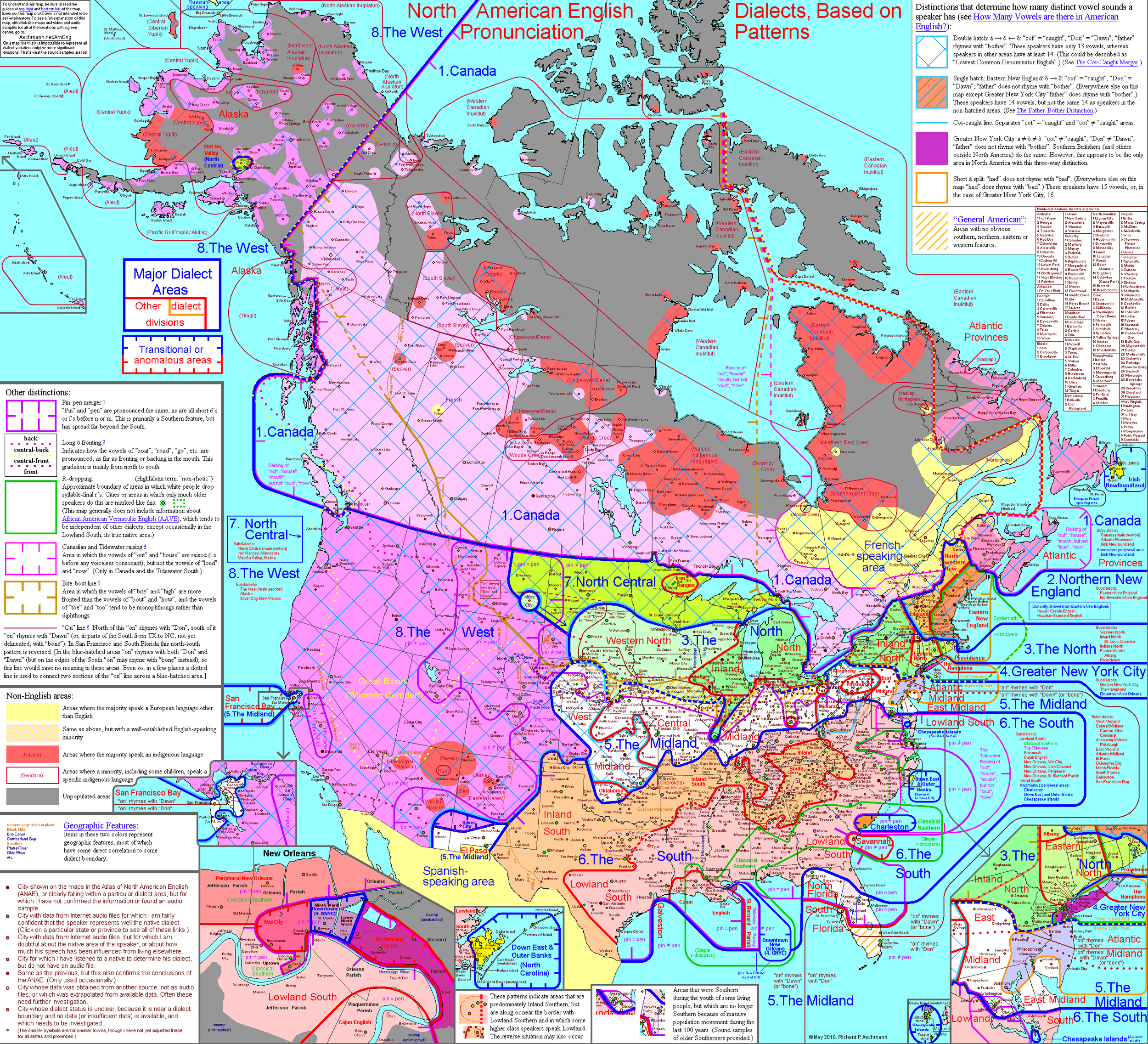
Dialect Map.

Climate Map.

Religious Map.

PROPOSITIONS OF UTAHISM
The core goal of Utahism is to simply redraw the states toward realities, and from this will naturally flow all the improvements that come from a more cohesive and representative federation. That being said, we would like to make some suggestions, propositions, and lay-out general guidelines/guardrails for how Utahism COULD to be implemented optimally:
Population Distribution: An ideal Utahist model would see every state require a minimum of one million citizens to qualify for statehood, and all the representation that would come from this. This number should, of course, be adjusted nationally as population changes, however, every state must be held to the same uniform federal standard rather than see the states allocated varying numbers of representatives for varying numbers of citizens; one representative per million citizens (scalable as population changes).
State Devolution: In the event a state falls dramatically below the one million population threshold (or whatever threshold exists at the time based on the total federal population) that state is liable to be devolved to a territory akin to Puerto Rico, retaining local representation. but seeing diminished federal representation until the local population can rebolster their numbers.
State Genesis: Inversely to devolution, should a population within a state which identifies itself as distinct, with unique interests of its own, surpass the population threshold, that population can petition the federal government for independent statehood from the current state it belongs to. An independent commission or body would be responsible for evaluating the distinctiveness of the population and its interests to prevent a large population from creating mere off-shoot states for itself to inflate its federal representation. If found to be sufficiently distinct, statehood will be granted to the population. For states based around major Metropolitan areas, multiply the population threshold by 5.
Integration of State Adjustments With Decennial Census: Consideration should be given for the coinciding of regular border adjustments with the census, allowing for expansion or shrinkage of a population to be accounted for. Short-term migration patterns and lifestyle developments thus would not result in dramatic redrawings year by year.
The census would also serve as an opportune time to consider annexation proposals for parts of one state to join another if significant population overlap is recognized. The infrequency of the census would help to discourage opportunists who may simply move to the border regions of a neighboring state, and petition for annexation to add territory to their own, as well as discourage reactionary activists protesting a short-term dispute.
Statehood Qualifications: When considering how the states should be redrawn it’s recommended that certain key factors are taken into account, though of course, not all need be necessary:
Religious Demographics
Ancestral Background
Economic Conditions
Environment / Geography
Cultural History
Infrastructure Integration
Natural Resources
